Something else from a long while back. . . Fine garden soil placed on top of a photopolymer plate before exposure makes the best cloud patterns imaginable. Don't use the vacuum and turn those fans off as you don't want that particulate matter getting into the machine. This might only work on steel-backed plates, since they don't flex.
Photopolymer plate phenomena
An interesting occurrence the other day. . . We were marking up some paper for cutting down with pencil notations (true cuts, gripper edge, etc.) and when we went to print prep we started with the top sheet cuts (with the markings) and noticed the pencil marks transferred to the photopolymer plate. When we applied a light, somewhat transparent ink, the pencil marks printed! and again, and again. Seems like there is some potential there for interesting work on solids.


Carbon dioxide bath for photopolymer plates
When the photopolymer plate process first emerged in the early 1960s, a standard industry practice was to revitalize used plates with a carbon dioxide bath. This was also used to condition raw photopolymer plates prior to exposure. This practice was discarded when plates were more and more considered disposable items.
However, this practice does revitalize photopolymer plates to some extent, and has been proven to relax some curled plates.
Previously procesed photopolymer plates degrade in the presence of ozone, UV light, moisture variance. Antiozonants and carbon dioxide act as preventatives.
A carbon dioxide bath is easily constructed. Any kind of small cabinet can be used as long as you can insert a wire shelf and a plastic container into it. The plates are placed on the shelf above the container and dry ice is put into the container. Let this sit until the dry ice has evaporated.
Deckle edge finder
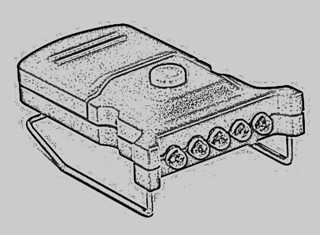
Printers may sometimes need to preserve the deckles on handmade or mouldmade paper but this can be problematic in registration. A not uncommon practice is to file away the deckle where the paper fits into the guides. This leaves a barely discernible registration edge that is even less so when the paper is dampened. This can be accomplished in a number of ways but to find the edge where the leakage (the deckle) begins and where the true edge of the paper thickness ends is quite difficult.
I was watching a student working on some deckle edged paper the other day and noticed he was using a small light and marking the paper with a pencil before making his cuts. When I inquired he showed me his device, a runner's mini LED (straight line) hat light clip on. He placed the paper with the deckle just beyond the edge of the table and ran the light along beneath the paper. The edging was perfectly revealed!
European composing sticks
![Sliders [composing sticks]](https://farm7.static.flickr.com/6187/6125610013_a668038f87_m.jpg)
Shown are two European composing sticks, both German (lower is a Bacher). These are extremely precise in regard to their parallel measure. As they use a sliding action they are best adjusted to the desired measure with a composing rule or a piece of furniture (preferably plastic Resalite or aluminum) rather than wood.
Ink Roller Supports (Bearers)
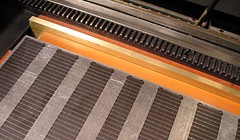
Shown here is a roller support (bearer) used to ensure that the inking rollers remain at .918 as they transverse the bed. Two are used, one on either side of the form, positioned near the ends of the rollers. The use of additional bearers was commonplace when furnishing reproduction proofs and Vandercook recommended them. The bearer mark was printed with the specimen.
These are 18-pt brass bar weld (full-face) rule made by Caslon Limited, UK (which no longer manufactures these). Similar bar weld, however, can now be obtained from Stephenson & Blake, Ltd., Sheffield, UK. These run the full printable length of the bed of a Vandercook SP-15. They support here two Bunting Magnetic Cerface Flat Bases. Shown also is Resalite plastic furniture.
The supports are usually chamfered and rounded at the surface edge ends to prevent roller nicking. To prevent wear on the supports the tympan is usually cut back.
Note: Temporary supports can also be made from strips of steel-backed photopolymer plate material, 18- to 24-pt wide and as long as the base. These should be placed at the edge of the base and outside of the printing area or incorporated along with the imaging. Polyester-backed plates can be used if incorporated with the imaging on the plate; strips of the plate material don't work as well though as without stronger support they curl and bend.
Photopolymer Plate Pickup
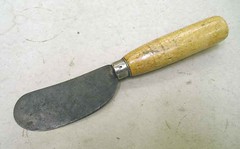
A pad knife (aka tablet knife) is a very convenient tool for lifting steel-backed plates on magnetic flatbases. The blade is short enough for convenient manipulation and wide enough to prevent the plate from bending; and its front rounded edge keeps it from scratching or cutting the surface of the base.
I also use this handy tool to remove washed out plates from the platen of the photopolymer platemaking machine.
These are commonly used to separate padding and are available from various distributors of printing and binding supplies.
Humidors
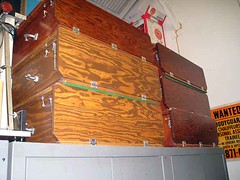
Humidor boxes used for storing and handling dampened paper during editioning. These were constructed on the model described in Lewis Allen’s Printing With the Handpress. These are all from the Glen Price version produced in the early 1990s.
Press points
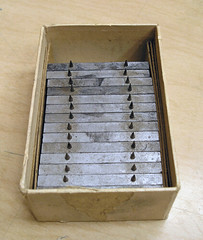
Steel press points are often used on cylinder presses such as a Vandercook to prevent slurring of the type at the bottom of the sheet. They are less than type high thus do not print. They are locked in the lower part of the form outside of the printing area. These catch the sheet as it flips away from the cylinder and prevent it from dragging across the type.
Side guide
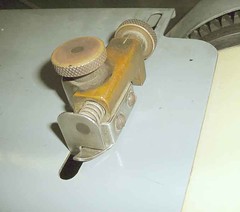
Old style Vandercook 219 brass side guide. Here it is shown mounted on a SP-15. Note flared lip (doesn’t abrade the paper sheet). I prefer this to the new style Vandercook guides. Reminds me of an old steam locomotive (when I was a kid, we had railroad tracks at the back end of our property, and these guys would fly by once or twice a day, really cool).
Registration Tool (plate shifter)
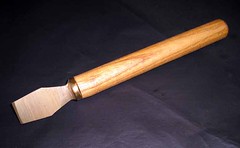
A bookbinder's brass pallet can be used for nudging steel-backed photopolymer plates into position. This works especially well on a Bunting Cerface Magnetic Flat Base. It will not scratch the surface nor be drawn down by the base magnetism.
Drawdown Third Hand
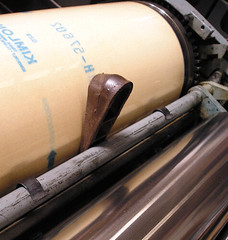
When adjusting the cylinder packing a lowly rubber door stop can be used to prevent the tympan draw sheet from drooping down onto the inked form and/or to prevent breaking friction fingers.
Subscribe to:
Posts (Atom)